
BRUSSELS, 28 July 2026 (MICE INSIGHTS)
A travel advisory standoff has left thousands of holidaymakers and business travellers facing a hard financial choice as wildfires sweep across France and Spain. While local authorities in worst-hit regions are actively pleading with tourists to stay away, major international governments have stopped short of issuing formal “do not travel” warnings.
This critical distinction leaves travellers trapped in an administrative gray zone: advised by locals to cancel for safety, but unable to recoup their money from insurance companies if they choose to do so.
This gap creates a severe insurance bottleneck:
- 📝 The payout trigger: Insurance coverage only activates if an official government advisory explicitly warns against “all or all-but-essential travel” to a specific zone.
- 🏨 The independent booking risk: If a traveler cancels a flight independently, accommodation providers located outside active evacuation zones are under no legal obligation to provide a refund.
✅ The realities on the ground: where you can still go
The vast majority of Western Europe remains completely clear, safe, and fully operational for travellers and event planners. Major metropolitan city centres like Paris, Barcelona, Seville, and Nice, along with the urban core of Madrid, are entirely unaffected by the fires and continue welcoming visitors normally.
Travellers looking for nature or outdoor alternatives can safely head to northern rural sectors like Brittany or mountain retreats in the French Alps, where conditions are clear. Strategic arrival infrastructure, including Madrid–Barajas Airport and coastal transit networks, continues to run standard schedules without structural disruption.
💨 Hazardous air quality: where you will find smoke plumes
Even outside the direct line of fire, heavy wind-driven smoke and severe particulate matter pollution are creating difficult conditions in several surrounding areas. A massive smoke plume drifts across the southwest transit corridor, heavily impacting visibility and air quality around Bordeaux-Mérignac Airport and its neighboring municipalities.
In Spain, shifting winds carry thick smoke from rural blazes eastward, causing fluctuating air quality and hazy conditions across the city limits of Madrid. Travellers visiting these perimeter buffer zones should expect poor visibility and potential flight or transit delays, even if the urban destinations themselves remain physically safe from the flames.
🚫 Exclusion zones: where travel is restricted
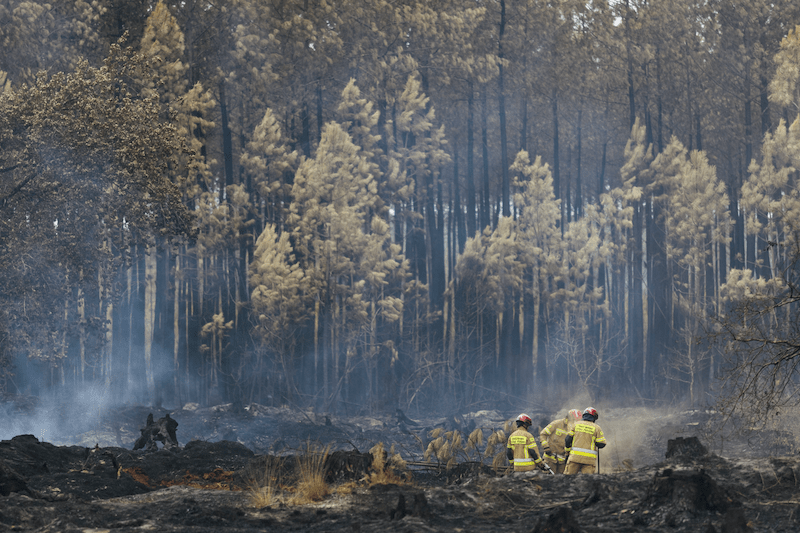
In southwestern France, the regional prefect has placed the Gironde and Landes departments under the highest alert levels, explicitly ordering the evacuation of coastal holiday camps in Lacanau and urging all tourists to stay away to keep emergency lanes clear.
In Spain, national emergency zones are tightly enforced across Ávila, Toledo, and the inland rural mountain communities surrounding Madrid. Entering these active perimeters is forbidden, as local emergency services continue to battle erratic fire lines and enforce strict roadblocks to protect public safety.
🧭 For those balancing upcoming travel departures, the operational strategy depends entirely on timing and booking structure. MICE INSIGHTS gathered some professional travel advice to help you decide:
- Package group travel: You hold the highest level of legal protection. If your tour operator determines the destination is unsafe and cancels the trip, you are legally entitled to a full refund or a flexible rebooking across all elements of the trip.
- Event venues and group accommodation: Review force majeure clauses in your vendor contracts immediately. Venues located outside active evacuation zones are under no legal obligation to waive cancellation fees, meaning regional smoke and transit delays do not automatically trigger contract releases.
- Traveling within 48 hours: Contact your airline and independent accommodation providers directly. While insurance may not pay out, many transit operators are quietly adjusting flexible rebooking options for flights into Bordeaux or Madrid.
- Traveling later in August or September: Do not cancel yet. Canceling weeks in advance guarantees you will forfeit your money and waive your right to a refund. Wait for operators and local conditions to adjust as departure dates approach.
- If you choose to go: Ensure your destination is completely clear of active zones via the France’s Forest Weather Map or Spain’s AEMET. Pack a dedicated emergency “grab bag” with passports, critical medicine, and essential clothing to ensure you can evacuate instantly if local police issue a sudden order.
Cover image: Fires in France. ©European Union, 2022


Leave a Reply